Application — Digital Forensics Isolate the device. Keep your hands on it.
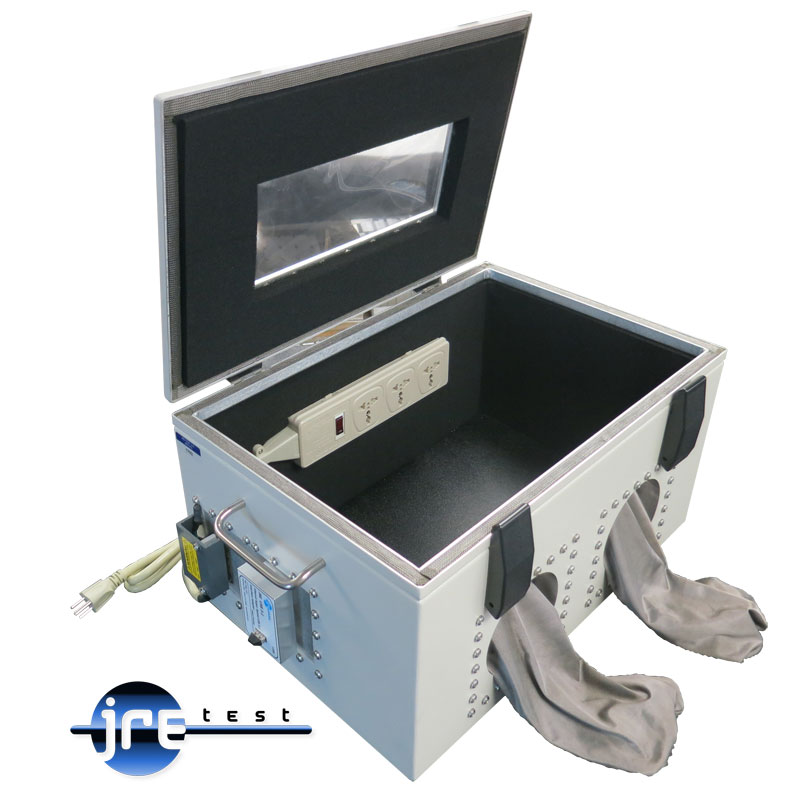
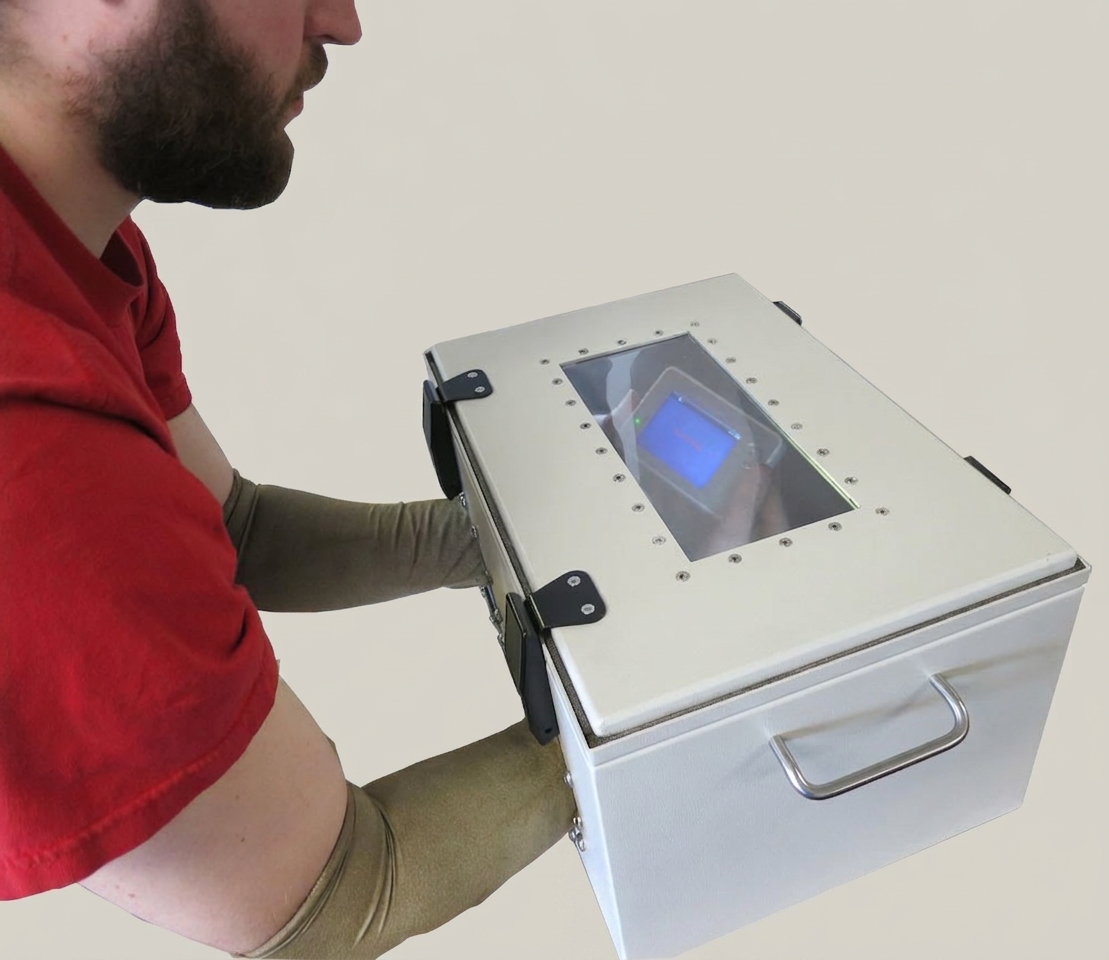
A seized phone has to be cut off from the network before it can be wiped, locked or tracked — and then it has to be worked on. The JRE 1812F holds the device behind RF shielding while an examiner reaches in and operates it, with a shielded window to watch the screen.
Conceptual — ambient bench RF (cellular, WiFi, Bluetooth) vs. a seized device inside the JRE 1812F (−80 dB isolation, DC–1 GHz).
- JRE 1812F
- −80 dB / DC–1 GHz
- Sleeve or shielded glove entry
A seized phone is still a live networked endpoint.
It is a device still logged in to its owner's account. The moment it reassociates with a cell tower or a known access point it can be remotely wiped in seconds — by Find My, Android's device manager or an enrolled MDM. Short of that, background sync and OS updates write to the exhibit after seizure, and a check-in tells whoever is watching the account roughly where the lab is.
The window to work in is bounded too: since iOS 18.1, an iPhone left locked and untouched reboots itself after 72 hours and drops back to a before-first-unlock state. Everything the examiner does has to happen without the device rebooting, losing power, or hearing anything from outside.
Works with GrayKey, Cellebrite UFED, and any USB-based extraction tool.
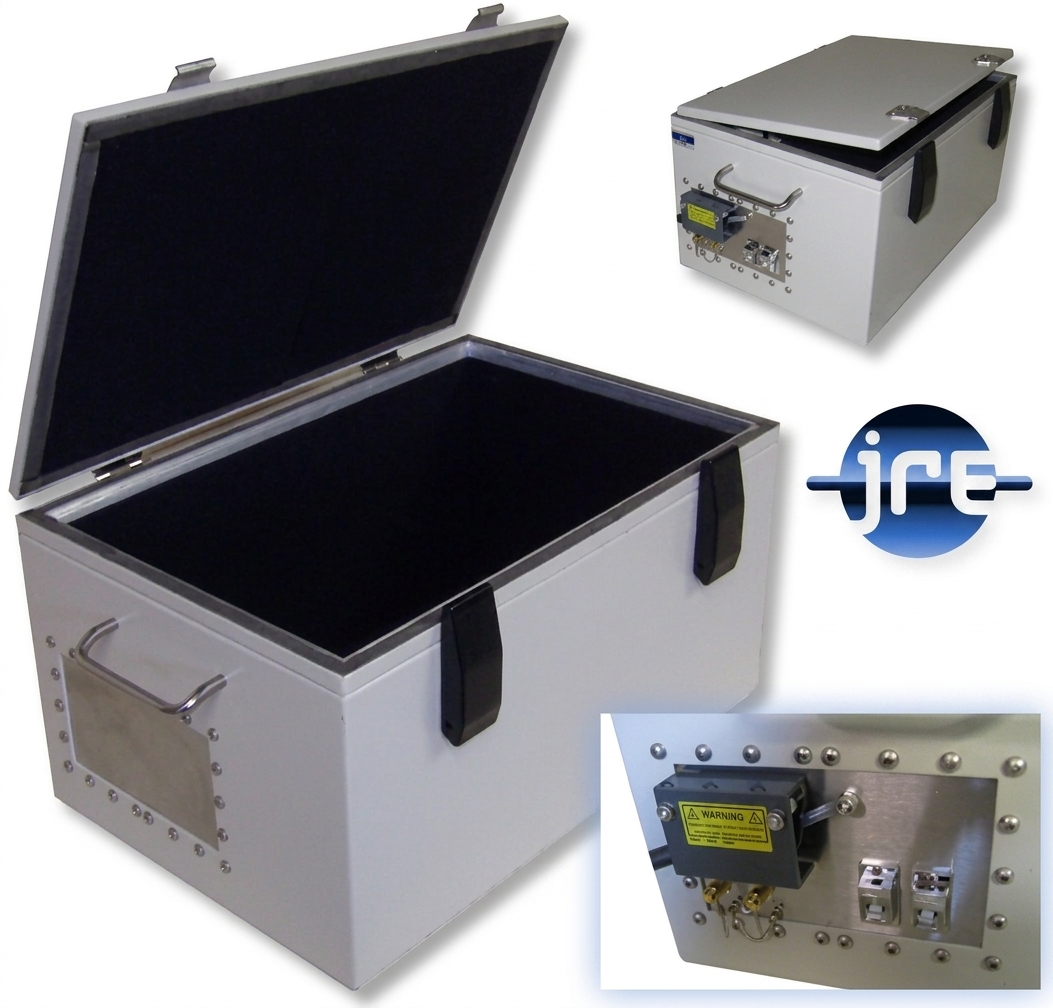
The enclosure doesn't need to know what tool you're running. GrayKey, Cellebrite UFED and any other USB-based extraction tool sit outside the shield and connect through the filtered I/O plate to the device inside. The filter is what makes that work: your data passes, while the carrier, Wi-Fi and GPS signals that would reach the phone are attenuated out.
- USB data Passes through the filtered plate Filtered USB 2.0 standard
- Cellular Attenuated out −80 dB DC–1 GHz · −75 dB to 3 GHz · −70 dB to 6 GHz
- GNSS / GPS Attenuated out −75 dB to 3 GHz
- Wi-Fi / Bluetooth Attenuated out −75 dB to 3 GHz · −70 dB to 6 GHz
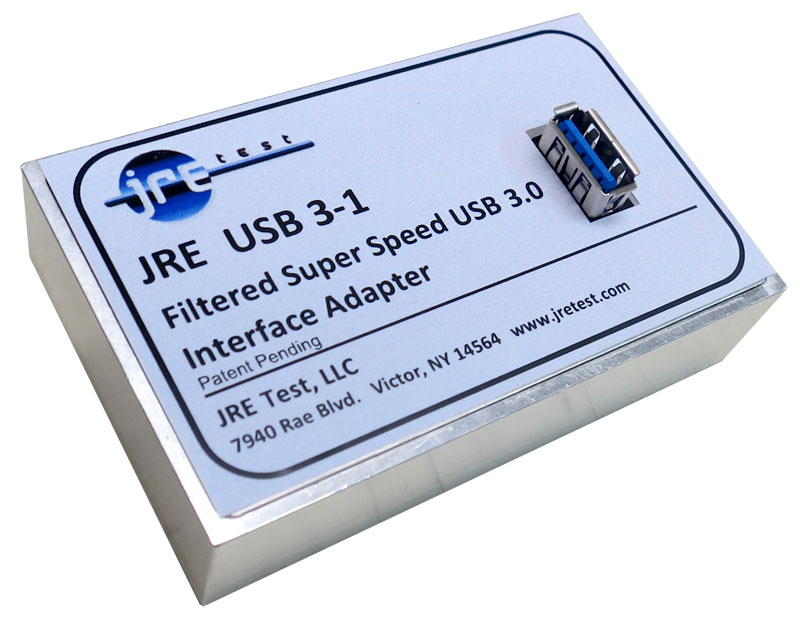
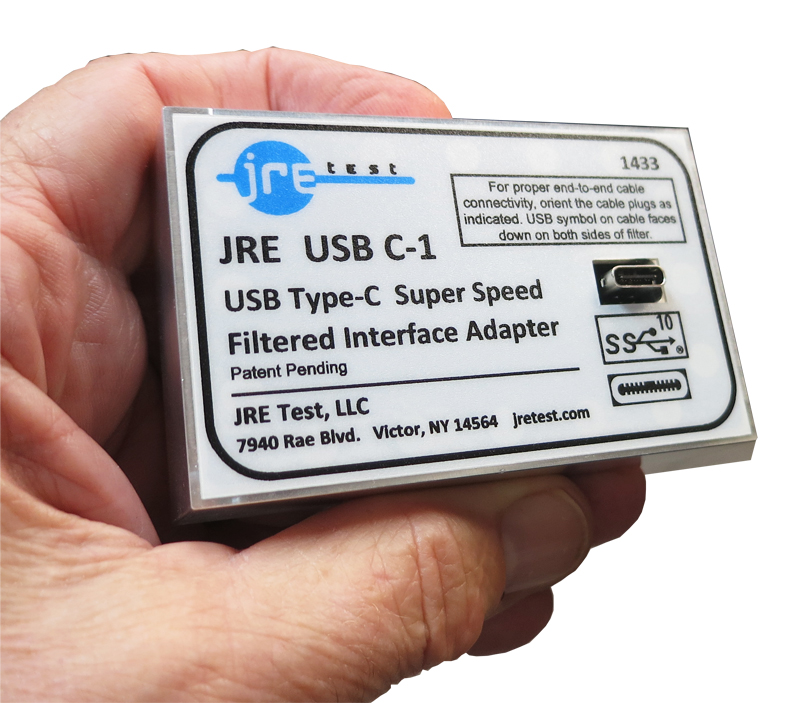
I/O plateJRE "B" size, 4.5" × 7" (115 × 180 mm) and field-changeable, so one enclosure covers more than one workflow. The 1812F ships with filtered USB 2.0 as standard; if your tooling runs USB 3.0 or USB-C, the passive USB3-1 or USB C-1 drops into the same opening at 80 dB isolation in test system configuration, with no active electronics in the path. Power comes in through a filtered entry to an internal universal AC power strip, so chargers and adapters stay inside the shield.
A cable run through an unfiltered pass-through is an antenna delivering outside RF straight into the shielded volume — the filtering is what preserves the isolation while still carrying the data. JRE Test does not supply extraction tools or services, and is not affiliated with any extraction-tool vendor; the tool names above describe how third-party USB hardware connects to a device under test.
Two ways in. Both invented by JRE's founder.
Sleeve entry and shielded glove entry are the two practical ways to get hands into a closed shielded enclosure, and the 1812F offers either one. John Ramsey developed both. The glove method went with his former company when it was sold, and that patent has since expired into the public domain — which is why we can offer both again.
- Conductive Spandex-style sleeves
- Hands come out bare inside
- Natural on a small touchscreen
- Conductive gloves bonded to the wall
- Skin never touches the exhibit
- Familiar to already-gloved workflows
Neither is a compromise version of the other — they are different ergonomics for different benches. Sleeve entry is covered by John Ramsey's US 8,294,044, live to ~2031. The glove method was patented by him at his former company and sold along with it; that patent has expired into the public domain, so it is no longer anyone's exclusive IP. Tell us which way your examiners work and we'll build it that way.
A window that shields, and light that doesn't breach it.
The patented viewing window is a laminated conductive mesh, so the examiner can watch and photograph the screen without opening anything. The interior lighting runs off a rechargeable Li-Ion pack — battery-powered specifically so it isn't another wire through the wall. Every hole you don't cut is shielding you don't lose.
- Window RF shielding Over 70 dB
- Light transmission Over 70%
- Interior LED ~350 lumens
Enclosures, filtered I/O and verification
Every price published. Configure the enclosure and the filtered I/O you need on a single combined inquiry — no cart, no checkout.
-
-
-
-
-
-


What the 1812F trades, and where it stops.
The 1812F trades isolation for visibility: −80 dB versus the windowless 1812's −100 dB.
If you need to see the screen, that's the trade. If you don't, take the extra 20 dB and specify the JRE 1812.
The window and the hand-entry openings are apertures, and apertures cost you. For forensic containment that is comfortably sufficient, and it is worth being precise about why: this is a different problem from RF conformance measurement, where 90–100 dB is needed to see signals near the noise floor. A cellular downlink at a bench typically runs somewhere around −60 to −90 dBm, and a phone needs roughly −110 dBm to camp on a tower at all. Knock 70–80 dB off and the device is well beneath what any receiver can do anything with — it sees nothing, hunts, and gives up.
If the same box also has to serve double duty for sensitive emissions measurement, that is a different requirement and probably a different configuration. Tell us and we'll say so.
The 1812F is specified to 6 GHz — watch the top of the band.
Wi-Fi 6E and Wi-Fi 7 operate up to 7.125 GHz, UWB sits around 6.5–8 GHz, and 5G FR2 is far above both. For most phone casework this is academic: the wipe command is going to arrive over cellular or 2.4/5 GHz Wi-Fi. But if your caseload includes newer handsets with 6 GHz Wi-Fi or UWB in play, ask us about the microwave (MW) upgrade, which extends performance to 28 GHz.
The isolation has to start before the bench — so the 1812F ships with a shielded Faraday evidence bag.
A bag is the right answer for transport: the device stays isolated on the trip from the point of seizure to the analysis bench, protected from remote shutdown, remote wipe and location tracking. What a bag can't do is let you work — you can't run a cable, hold mains power, see the screen, or get hands on the device inside a sealed pouch.
Shipping both closes the chain: seized into the bag, carried to the lab, transferred into the enclosure without the device ever seeing a network.
The enclosure is a containment tool, not an access tool.
It doesn't help anyone get into a phone, and we don't claim otherwise. What it does is make sure the phone you finish with is the phone you started with — no wipe, no pushed credential change, no background sync writing to the exhibit after seizure.
JRE Test does not supply extraction tools or services, and is not affiliated with any extraction-tool vendor.
Frequently asked questions
Yes. The tool stays outside the shield and connects through the filtered I/O plate to the device inside. GrayKey, Cellebrite UFED and any other USB-based extraction tool are USB devices connecting to a device under test — the filtered plate carries that connection across the shield wall while attenuating the cellular, Wi-Fi and GPS signals that would otherwise reach the phone. The 1812F ships with filtered USB 2.0 as standard, and the passive USB3-1 or USB C-1 drops into the same B-size opening if your tooling needs it.
JRE Test does not supply extraction tools or services, and is not affiliated with any extraction-tool vendor.
Yes. Sleeve entry uses conductive Spandex-style sleeves: your arms pass through and your hands come out bare inside the enclosure, with full tactile feel on the screen and no glove bulk. The 1812F also offers legacy shielded glove entry for labs that prefer to keep skin off the exhibit entirely. Both keep the enclosure closed while you work.
About 20 dB. The 1812F is specified at −80 dB from DC to 1 GHz, −75 dB to 3 GHz and −70 dB to 6 GHz; the windowless JRE 1812 is specified at −100 dB from DC to 1 GHz, −95 dB to 3 GHz and −85 dB to 6 GHz. The window and hand-entry openings are apertures, and apertures cost isolation. For forensic containment 70–80 dB is comfortably enough to starve a phone's receiver of usable ambient signal — if you don't need to see the screen, take the extra 20 dB.
Keep it from reaching a network at any point between seizure and analysis. A phone that reassociates with a cell tower or a known access point can receive a remote erase command from Find My, Android's device manager or an enrolled MDM, and it executes in seconds. The 1812F ships with a shielded Faraday evidence bag for the transport half of that chain; the enclosure covers the working half, so the device moves from bag to bench without ever seeing a network.
Go deeper — engineering guides
- Inside the phone crackers: how forensic extraction tools work The white paper behind this page — BFU vs AFU, the 72-hour clock, and why the bench has to be RF-quiet.
- Measuring and verifying shielding isolation How the isolation numbers are measured, and how to check yours on the bench with the TVK-2.
- USB-3 and USB-C special considerations Why JRE keeps the filters passive — no firmware, no microcontrollers, nothing in the signal path to compromise.
- Why filtered I/O? What one unfiltered cable does A conductor has no cutoff frequency. One unfiltered cable drags a −100 dB enclosure to −40, with a live simulation of the leak.
Talk to us about a forensics bench.
Tell us the devices you're working with and how you need to get at them — we'll configure the enclosure, the sleeve or glove entry, and the filtered I/O, and quote it.