

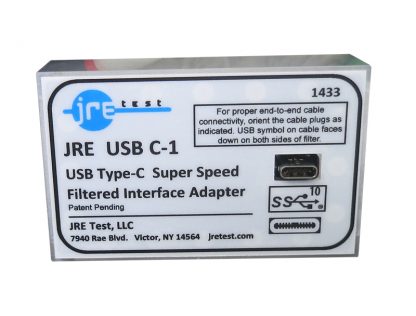
Description
Test USB Type-C "SuperSpeed" devices in a sealed RF environment without throttling your data. The USB C-1's patented design is not a low-pass filter, it rejects wireless RF interference without touching the high-speed data the way conventional filters do.
- Fully passive USB Type-C interface, transparent to USB 2.0, USB 3.x "SuperSpeed," USB4 and Thunderbolt (the connector and the filter are the same across all of them)
- Patented signal-phasing topology, NOT a low-pass filter — discriminates data from RF interference rather than attenuating both
- No inherent data-speed limit in the filter itself — achievable speed is set by total cable attenuation, not by the filter
- Proper USB enumeration over a direct "copper" path — test hiccups are exchanged end-to-end, with none of the silent hang-ups a fiber or media-converter link can hide
- Fully passive by design — no active components, no firmware, nothing that could be subverted in a data-side attack
- 100% made in USA
- USB-C PD 3.1 power delivery up to 240 W (48 V, 5 A) — power capability is independent of data speed
- ~80 dB conducted attenuation, 50 MHz to over 6 GHz
- Appears to the link as roughly 1–1.5 m of USB-C cable — budget for it in your overall cable length
- One USB-C male-to-male jumper cable included
- Rugged machined-aluminum housing
- Works with any RF test enclosure or screen room
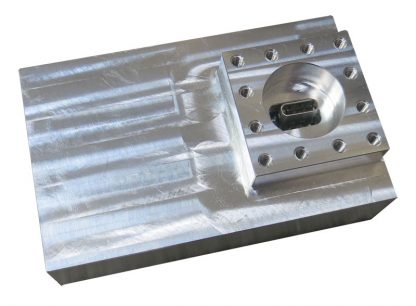
The JRE USB C-1 is a fully passive USB Type-C filtered interface built into a machined-aluminum housing that gives exceptional RF shielding on every data and power line. The same connector and the same filter carry everything from USB 2.0 through USB 3.x SuperSpeed and on up to USB4 and Thunderbolt, the difference between those is data rate and cabling, not the interface.
It works on an entirely different principle from older USB filters. Earlier designs low-pass filtered the data lines to knock down interfering wireless RF, but as USB rates climbed into the SuperSpeed range, the data itself moved up into the same frequency band as the interference, and a low-pass filter can no longer tell them apart: it attenuates both. Our patented design instead exploits the fact that the USB data travels as a balanced differential signal while the interfering RF appears as common mode. Using signal-phasing techniques and topology, it discriminates between the two, rejecting the RF while passing the data clean, with no low-pass filtering anywhere on the data conductors, plus filtered power and return lines.
Speed, cables, and power: what actually governs your data rate. The filter has no speed limit of its own; electrically it "looks like" roughly 1 to 1.5 meters of USB-C cable, and it's the total attenuation of the filter plus your connecting cables that sets the achievable rate. With the short jumper included, you'll reliably pass 5 Gbps and often 10 Gbps, depending on how robust your devices are. For the faster grades — 20 Gbps, or Thunderbolt/USB4 at 40 Gbps — use an active cable on the outside of the chamber; active cables carry built-in conditioning that makes up for cable loss. And there's a built-in safety net: if total loss is too high, the USB/Thunderbolt protocol simply negotiates down to a speed it can sustain rather than failing silently. One common trap worth calling out — a cable's wattage rating (the "100 W" or "240 W" you see on PD cables) describes power delivery, not data performance. A 240 W cable can still be far too lossy for 40 Gbps. Keep passive runs to about 1.5 m total, and reach for an active cable when you need more. There's a full write-up in our USB-3 and USB-C Special Considerations white paper.
The fully passive design is deliberate. We could put active equalizer or regenerator chips inside the filter — we choose not to, because a fully "copper," passive path is exactly what sensitive-data and secure testing demands: no active silicon, no firmware, nothing in the data path that could be compromised. When you need to make up cable loss, that conditioning lives in an external active cable you control, not buried inside the wall. Combined with 100% USA manufacturing, that makes the USB C-1 an easy fit for defense and security work.
Standard USB Type-C connectors make for simple, reliable hookup, and because the connection through the filter is direct copper, your devices enumerate normally and exchange any test hiccups between themselves — none of the undetected hang-ups that fiber-optic or media-converter interfaces can introduce. The data filtering passes USB 2.0, 3.x SuperSpeed and faster while providing 80 dB of rejection to undesired wireless RF.
Reliable shielding starts at the mounting. The USB C-1 secures to the enclosure wall with a ring of 4-40 screws (drilling template included for standalone installation), drawing the filter flange flat and tight against the wall around its entire perimeter. We have tested competitive filters that use a single center hole and a large securing nut — those are prone to leakage, because the coarse nut thread never seats the body reliably flat, and a single mechanical anchor works loose over time. Even a tiny loss of contact pressure opens an RF leak. Every USB C-1 specification is measured with the filter installed in an enclosure, and it holds that performance no matter how many times the connector is mated or the filter gets bumped and jostled on the bench. The compact footprint also leaves room for more filters on the same I/O plate.
Download datasheet: USB C-1
Download hole pattern and drawing: USB-C Layout
Mounting screws are 4-40 and included with filter. Clearance hole size is 0.1285" diameter - #30 or 3.3mm drill
Features and Benefits
- Patented unique design discerns between data and RF signals
- Extremely wideband operation, from low VHF through microwave
- Low loss, appears to the devices as just a longer USB C type cable
- New version meets USB-C PD 3.1 Power Delivery up to 240W 48V 5A
- Heavy duty machined aluminum case for reliable shielding and ruggedness
- Multiple points of attachment secures without rotation or loosening
Specifications
- Insertion Loss on Data lines: less than 5 dB
- 80 dB isolation in test system configuration
- Data Line Balanced Impedance: 90 Ohms typical
- DC Power line: 0.2 ohms DC resistance, -20 db @ 1 MHz, -80 db @ 10 MHz to 6 GHz
Dimensions
Outside: 2" H x 3.2" W x 0.8" D (50 x 80 x 20 mm)
JRE USB C-1 Filtered USB type C 'SuperSpeed' Interface Adapter
USB Inside: USB Type C Female connector
USB Outside: USB Type C Female connector
Cable: Two type C Male to Male jumper cables included
Power capability: USB-C PD 3.1 240W, 48V, 5A maximum. DC resistance each leg, 0.2 ohms max.
Compatibility
JRE Test’s RF Shielded Test Enclosures deliver real value and save time over in-house fabricated test solutions. Our fast off-the-shelf delivery, unbeatable price and performance make us the first choice for all your RF test needs. The industry's widest line of enclosures provides superior RF isolation from 10 MHz to over 6 GHz, covering the entire range of popular commercial, private and government communications systems. Whether you are designing, integrating, or conformance testing the next generation Wi-Fi, WLAN, 3G Cellular device, you can rely on JRE Test to provide a seamless solution that is compatible with today’s technology and is ready for the future.