
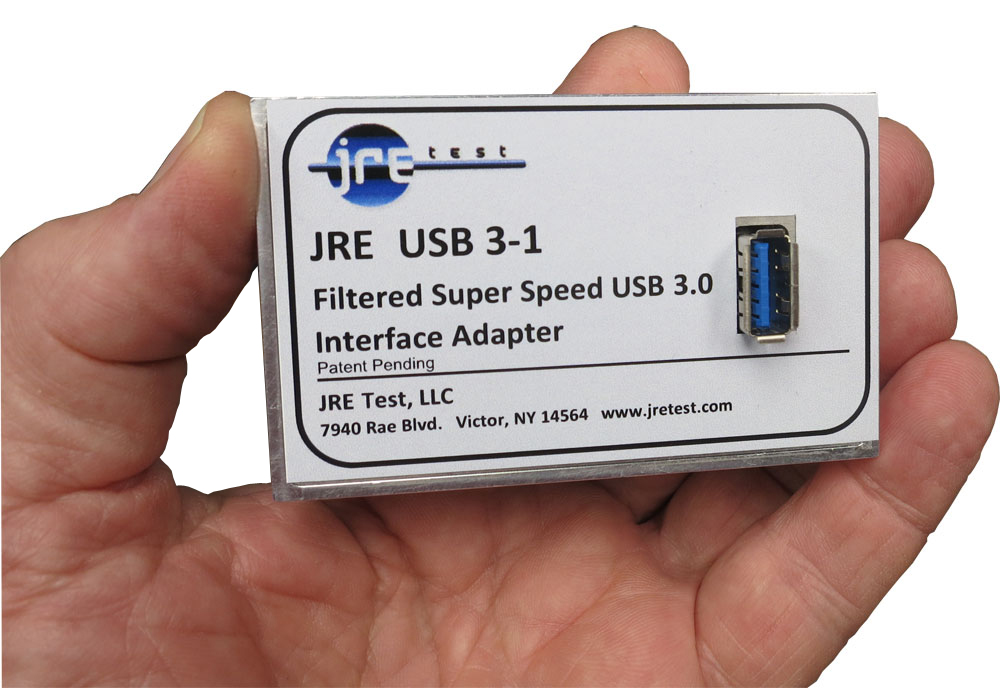
USB 3.0 'SuperSpeed' Filtered Interface — JRE USB3-1
Passive, patented filtered USB 3 SuperSpeed interface on Type-A connectors that passes 5 Gbps data through the shield wall; male-to-male jumper included.
JRE USB3-1 specifications
- Outside dimensions
- 2" H x 3.2" W x 0.8" D (50 x 80 x 20 mm)
- Isolation
- 80 dB isolation in test system configuration
- Insertion Loss on Data lines
- less than 1.5 dB
- Data Line Balanced Impedance
- 90 Ohms typical
- DC Power line
- 0.1 ohms DC resistance, −20 dB @ 1 MHz, −80 dB @ 10 MHz to 6 GHz
- Conducted attenuation
- ~80 dB, 50 MHz to over 6 GHz
- USB Inside connector
- USB 3.0 Type A Female connector
- USB Outside connector
- USB 3.0 Type A Female connector
- Cable included
- Type A Male to Male jumper cable included
- Power capability
- USB standard or up to 50 VDC at 1 amp. DC resistance each leg, 0.1 ohms max.
- Mounting screws
- 4-40 screws included; clearance hole size 0.1285" diameter - #30 or 3.3mm drill
- Housing
- Rugged machined-aluminum housing
- Manufacturing
- 100% made in USA
- Data rate
- 5 Gbps, often up to 10 Gbps
JRE USB3-1 overview
Yes — the USB 3-1 carries a full USB 3 SuperSpeed (5 Gbps) link, often up to 10 Gbps depending on your devices and cabling, while keeping wireless RF out of your shielded box. It is a fully passive filtered interface on standard Type-A connectors that operates at every USB speed — USB 1.1, 2.0 and 3.0 — and stays fully USB compliant, so it drops into the I/O plate of any RF test enclosure or screen room without throttling your data.
How it keeps RF out without corrupting your data
Every connection you run through the chamber wall is a potential antenna — left unfiltered, it bypasses the shielding entirely. The hard part at SuperSpeed is that your 5 Gbps data has climbed up into the same frequency band as the Wi-Fi and cellular RF you are trying to block, so an ordinary low-pass feedthrough can no longer tell them apart: it attenuates both and mangles the data.
Our patented signal-phasing design solves that by discriminating on signal mode rather than frequency. The balanced differential USB data passes through unfiltered — there is no low-pass on the data conductors and no upper frequency limit on your signal — while the common-mode RF (the interference, which rides equally on both conductors) is filtered out. The power and return lines are filtered as well, and the interface carries either USB-standard bus power or up to 50 VDC at 1 A for an externally powered device, at 0.1 Ω of DC resistance per leg. That is JRE patented technology, covered by issued US patents; you can read more on our patents page.
Because it keys on mode and not frequency, the filter keeps doing its job even when your data and the RF you are blocking land in the same band — exactly what happens at SuperSpeed, and also in keyfob and RFID pass-band testing where the signal you are measuring shares the spectrum you are trying to keep out.
In a test-system configuration it gives roughly 80 dB of RF rejection from 50 MHz to past 6 GHz, with under 1.5 dB of insertion loss on the data lines and a 90 Ω typical balanced impedance — so the shield holds while your link stays clean. The DC lines run 0.1 Ω resistance with their own filtering, from −20 dB at 1 MHz down to −80 dB across 10 MHz out to 6 GHz.
What actually governs your data rate
The filter has no speed limit of its own. Electrically it appears to your devices as about a one-meter USB 3 cable, and it is the total attenuation of the filter plus your connecting cables that sets the achievable rate. With the included Type-A male-to-male jumper you will reliably pass 5 Gbps and often up to 10 Gbps. If you need a longer run, use an active cable or a powered hub — the regeneration then lives in a part you control, not buried in the wall. And there is a safety net: if total loss is too high for SuperSpeed, the USB protocol simply falls back to a slower speed (down to USB 2.0) to keep the link alive rather than failing silently. Our "USB 3 and USB-C Special Considerations" write-up walks through the cable math in detail.
Built for secure and defense work
We keep it fully passive on purpose — no active silicon, no firmware, nothing in the data path that could be subverted. Because the path is direct "copper," your devices enumerate normally and exchange any test hiccups end-to-end, with none of the silent hang-ups a fiber or media-converter link can hide. It is 100% made in USA, which matters when procurement or an RFP calls for it.
Which USB filter do I need?
- USB 2-1 ($369) — a low-pass filter, the right pick when your link runs at USB 2.0 speeds.
- USB 3-1 ($480, this unit) — patented signal-phasing for USB 3 SuperSpeed (5 Gbps and up).
- USB C-1 ($569) — the same patented architecture on a USB-C connector.
If you are not certain which speed you are running, that is exactly the question we pin down before quoting — tell us the device and we will match the filter.
It mounts with a ring of 4-40 screws (drilling template included for standalone installation), drawing the flange flat and tight against the wall around its entire perimeter.
How to order
The USB 3-1 is $480. There is no cart — we build to spec. Send us your device, your link speed, and your connector list through a quote request, and our engineering team will confirm the right USB filter and the rest of your I/O, then hand the locked configuration to our sales team for a formal quote and freight. Ask an Engineer to get started.
Every chamber we build has a file. Your build is logged by serial number — the enclosure, the plate layout, every connector and filtered interface — with build and test records on file since 2005. Years down the road, send us the serial number and we reproduce or revise your exact configuration, with no re-engineering and no guesswork.
Go deeper
Used in: High-Speed Data · Defense & Security
- USB 3 and USB-C Special Considerations Why high-speed USB drops to 2.0 through an RF filter, what speeds to expect at 5/10/20/40 Gbps, and when an active cable is required for the test setup.
- Understanding data signals through filtered I/O The three filtering approaches — capacitive, low-pass, signal-phasing — and when each one applies.
- The effect of adding multiple I/O filters The weakest-link principle and the 3 dB-per-doubling rule for your system isolation budget.
- Interface & connector guide Match every connector and capacitance value to your signal type on the removable I/O plate.


Tell us what connections your device needs.
Tell us what connections you need to your device under test — USB, Ethernet, RS-232, RF connectors, etc. We'll spec it out with you. No cart, no checkout: you send an inquiry and we quote it.
Ask an Engineer