Application — Production & QA A test station that gives the same answer every time.
Production RF testing lives or dies on repeatability. A benchtop JRE enclosure gives you an RF-sterile volume, a removable ABS floor you drill into a fixture, and custom hole patterns cut in-house — so every unit sits in the same place, sees the same path, and gets measured against a known-good gold standard.
Conceptual — ambient bench RF vs. inside the enclosure, where every unit sits in the same place, sees the same path, and gets measured against a known-good gold standard.
- REMOVABLE ABS FLOOR
- CUSTOM HOLE PATTERNS CUT IN-HOUSE
- KNOWN-GOOD GOLD STANDARD
Inside a small chamber, geometry is everything.
A benchtop enclosure is a near-field environment — antenna gain, pattern and polarization simply do not apply the way the datasheet describes them.
- Move the DUT half an inch
- Antenna position, cable routing and DUT placement vary
- Inconsistent readings
- Fixed fixture, fixed cabling and a fixed antenna position
- Identical coupling path from unit to unit
- Measure against a known-good 'gold standard' device
That sounds like a problem, but for production testing it is exactly the point. You do not chase an absolute field-strength number: characterize one known-good 'gold standard' device, record it, and measure every production unit against that benchmark using the identical setup. The chamber's job is to be consistent — and a well-fixtured JRE enclosure is consistent enough to calibrate a pass/fail line around.
From bare enclosure to repeatable line test.
Build the fixture on the removable ABS floor.
Every chamber ships with a 0.062" ABS floor that lifts straight out — no fasteners. Pull it to your bench, drill or tap it for your DUT, add threaded inserts or a custom acrylic cradle, and drop it back in. Replacements run ~$25–$50, so you can keep a floor drilled per product and swap them.
Set a fixed, repeatable geometry.
Lock the antenna position, cable routing and DUT placement. Keep cables short and tidy — don't coil service loops near the antenna. Whatever distance and orientation you settle on, write it down and replicate it every run.
Benchmark a gold-standard unit, then test against it.
Path loss inside a small chamber is hard to predict from theory — quarter-wave figures run ~30 dB at 433 MHz, 40 dB at 916 MHz, 30 dB at 2.4 GHz; the BBA-1 adds ~25 dB. Calibrate with a known-good device, then run production units against that benchmark all day.
Mounting Devices Inside an RF Shielded Test Enclosure
Read the guide before you drill anything. It is the full method behind steps 1 and 2 — how to work the removable ABS floor, when a custom hole pattern is worth cutting, how to route and dress cabling, and which fixture materials wreck the RF environment.
Build the fixture without disturbing the RF environment.
$25–$50 → Replacement ABS fixture floors — one per product
Pull out the ABS floor, drill it for your fixture, drop it back in. Keep metal out of the test volume. Keep cables short and tidy. Use a gold-standard device to benchmark.
Source: Mounting devices inside an RF shielded test enclosure
$150–$200 → Custom in-house hole pattern — first wall; about $125 for each additional wall
If you drill a chamber wall, every hole must be filled with a tight metal screw to keep the shield continuous.
ABS → Plastic floor is RF-transparent — the absorber underneath works as if the plate weren't there
Keep metal out of the chamber — any sizable metal piece is a reflector that fights the absorber foam. Use plastic, ABS, acrylic or wood for fixtures.
Build your test station
Every price published. Pick a size with room for your fixture, an antenna for your band, and a way to verify the station — on one combined inquiry.
-
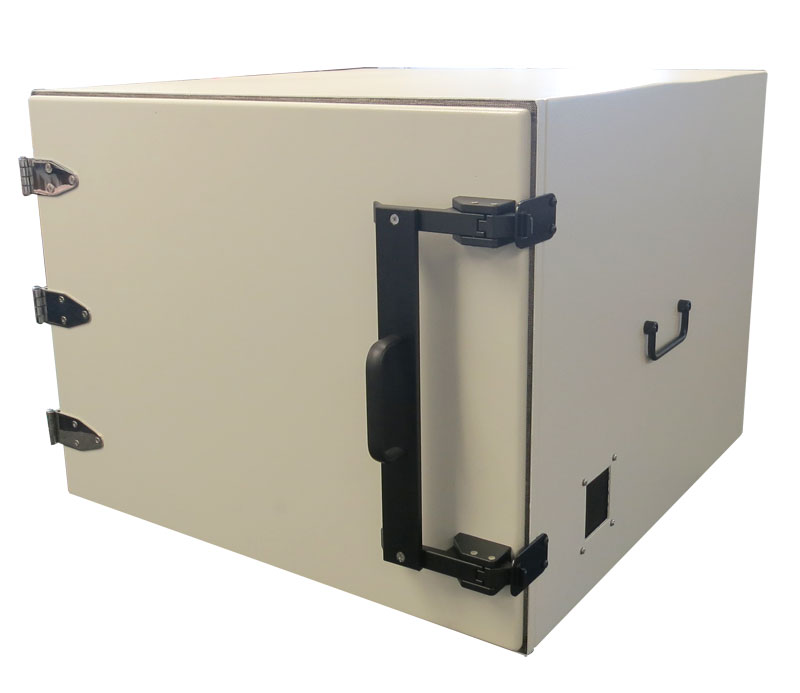
-
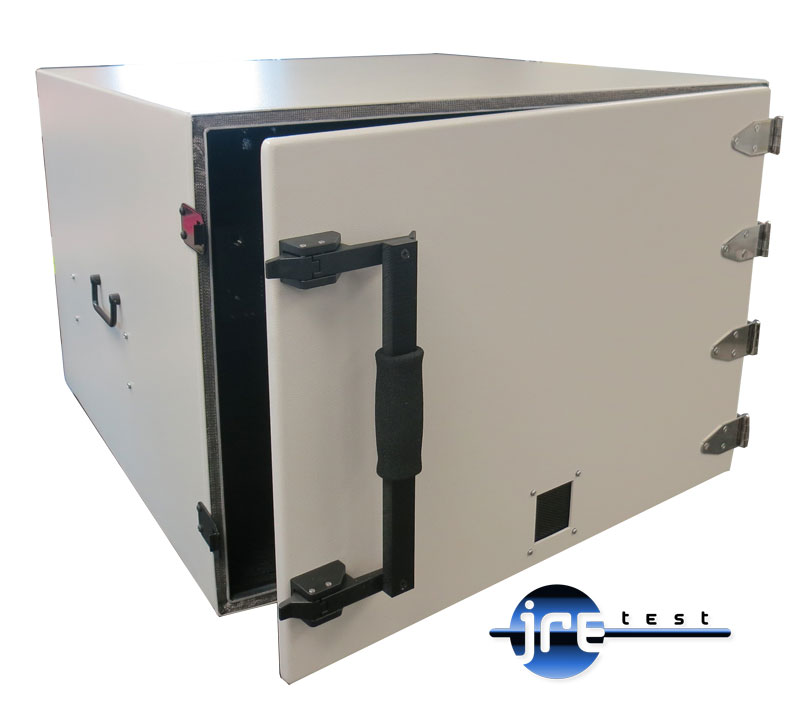
-
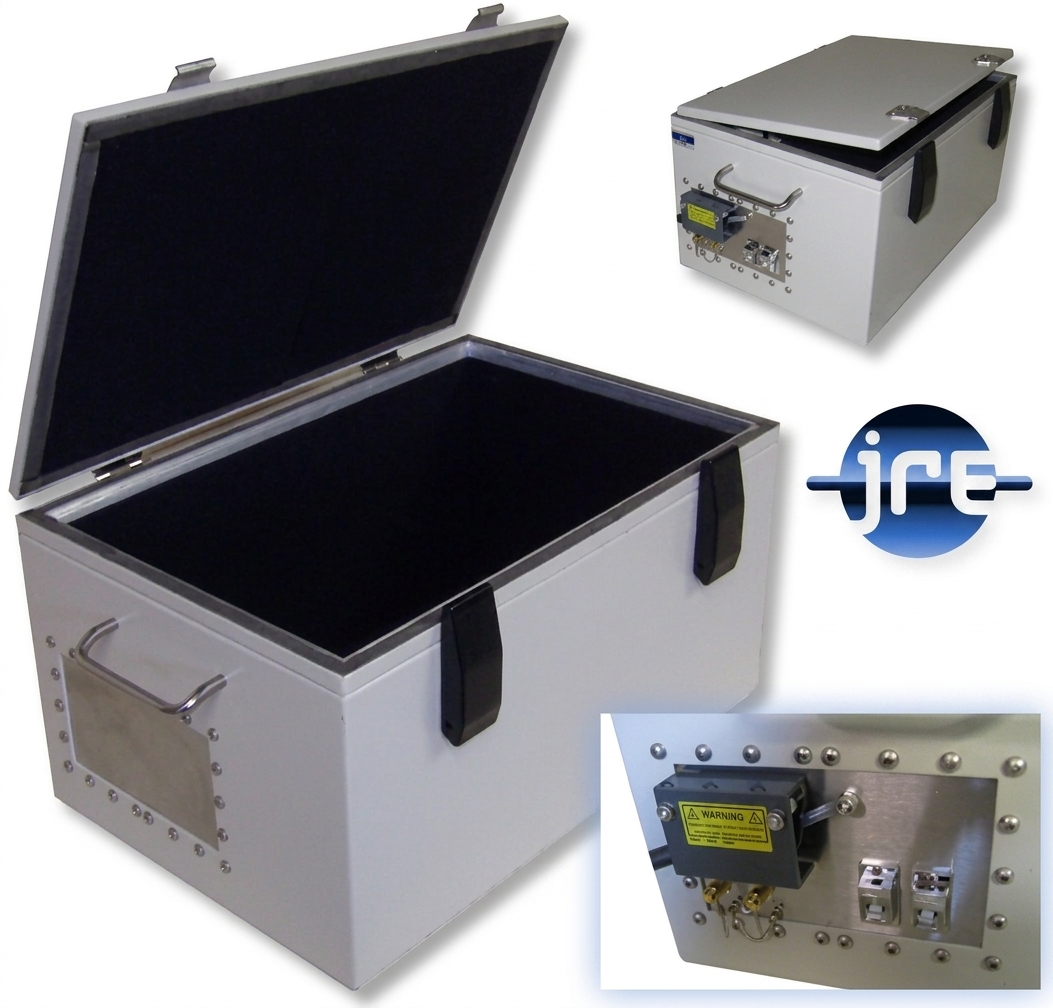
-
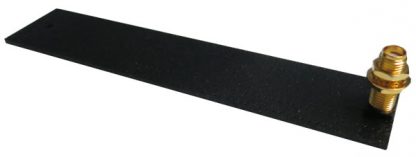
-
-


Frequently asked questions
Characterize a known-good device, record the result and test every production unit with the same antenna position, cable routing and DUT placement. The comparison is relative to that gold standard.
Use plastic, ABS, acrylic or wood. The removable ABS floor can be drilled for the fixture, while keeping sizable metal parts out of the test volume avoids reflections that work against the absorber.
JRE can cut a custom hole pattern in-house. Every drilled hole must be filled with a tight metal screw so the conductive shield remains continuous.
Go deeper — engineering guides
- How to radiate signals using antennas Path-loss figures, gold-standard benchmarking, distance simulation with a step attenuator, and interference injection.
- Understanding antenna performance inside an enclosure Why repeatability beats accuracy in the near field — and why the lossy BBA-1 is the safe production choice.
- Mounting devices inside an enclosure The removable ABS fixture floor, custom hole patterns, cable management and fixtures to avoid.
- Measuring and verifying shielding isolation Confirm the station still shields correctly after you reconfigure or move it on the line.
Spec your production test station.
Tell us the DUT, the band and your fixturing needs — we'll configure the enclosure, I/O plate and custom hole pattern and quote it. Listed enclosures — including a customer-configured I/O plate — are built and shipped in 3–4 days; fully-custom dimensions run 12–16 weeks plus $3,500–$4,500 NRE.