
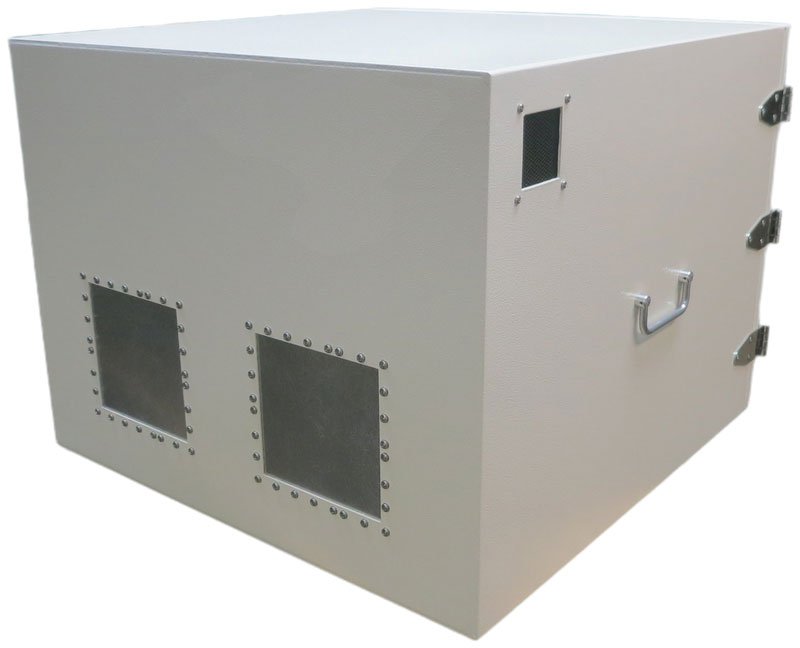
RF Shielded Test Enclosure — Benchtop — JRE 2525
Large benchtop enclosure with an 18" H x 23.5" W x 23.5" D interior, two C-size I/O plates, and a 46-lb UPS-shippable build.
JRE 2525 specifications
- Inside dimensions
- 18" H x 23.5" W x 23.5" D (460 x 600 x 600 mm)
- Outside dimensions
- 19.5" H x 25" W x 25" D (495 x 635 x 635 mm)
- Isolation
- −100 dB DC to 1 GHz, −95 dB to 3 GHz, −85 dB to 6 GHz
- Weight
- 46 lbs (20.9 kg)
- Shipping Weight
- 70 lbs (31.8 kg)
- Shipping Dimensions
- 31" x 31" x 26" (790 x 790 x 660 mm)
- I/O Plates
- Two removable C-size (7" x 7" / 180 x 180 mm)
- RF Absorbing Foam
- LS-30, 3/4" (19 mm) thick, 90°C temp rating, UL 94V-0
- Door Hinges
- Heavy duty triple stainless steel
- Construction
- Rugged welded aluminum
- Vents
- Two honeycomb style vents standard; fans optional
- Optional MW Upgrade
- > 85 dB isolation to 28 GHz
- Keyed Locking Latch
- Optional, add $29
JRE 2525 overview
If you're validating a multi-radio device — cellular, GPS, LoRa, BLE and Wi-Fi all living in one product — or you need to fit larger gear (or more than one DUT) inside a sealed RF environment, the 2525 is the size I steer most IoT and asset-tracking customers to. It gives you a big, cube-shaped interior with two removable C-size I/O plates where the mid-size 1812 has a single B-size plate. That's roughly three times the filtered-interface surface area, so a multi-protocol device with a long connector list has room to breathe and somewhere to land every filtered line.
It's still benchtop-sized and UPS-shippable. Pick it over the 1812 when you've outgrown a single B-size plate and a smaller box; step up to the 2830 (three plates, $4,060) only when you need even more room than this.
- Roomy, near-cube interior sized for large or multiple DUTs, in a compact benchtop footprint — exact inside and outside dimensions on the spec lines below
- RF shielding isolation: −100 dB DC to 1 GHz, −95 dB to 3 GHz, −85 dB to 6 GHz
- Two removable C-size I/O plates (7 in x 7 in) — wide selection of filtered interfaces, reconfigurable as your test needs change
- Only 46 lbs — ships worldwide by UPS, no pallet required, saving thousands in crating and freight (rivals this size often top 100 lbs and have to be crated)
- Rugged welded aluminum, heavy-duty triple stainless-steel hinges, dual latches, long-life door gasket, LS-30 absorbing foam; keyed locking latch optional (add $29)
- Two honeycomb-style shielded vents standard for passive airflow; an optional 80 mm vent takes an AC or DC fan when your device needs forced-air cooling
- Optional MW upgrade extends isolation to >85 dB out to 28 GHz for 5G FR2, UWB, and Wi-Fi 6E/7 work
- Ships bare — no RF connectors or interface filters are included; every connection is specced and filtered to order (more on that below)
Will my device fit?
The interior swallows larger DUTs, gives you room to place an internal antenna and route cable, and is generous enough to hold more than one device at a time. I originally designed the 2525 for testing rack-mounted RF sensing equipment, so it suits large wireless gear — rack-mount mesh APs, cellular/LTE base stations, wireless laptops, test fixtures for big RF modules — as comfortably as it suits a small tracker board. Heavy-duty triple stainless-steel hinges and dual latches pull the extra-wide door sealed RF-tight, and the wide opening leaves room to place and reposition devices while you work. Inside, LS-30 absorbing foam tames reflections and hot-spots so your measurements stay clean and repeatable.
Does the shielding cover my bands?
The −100 / −95 / −85 dB curve to 6 GHz covers the usual IoT band mix with margin — GPS around 1.5 GHz, cellular/LTE, LoRa, BLE, and 2.4/5 GHz Wi-Fi — so you can inject controlled GPS or cellular signals and run over-the-air work without raising the noise floor in the room. If your device reaches into 6 GHz-plus territory (Wi-Fi 6E/7, UWB, 5G FR2), the optional MW upgrade extends isolation to >85 dB out to 28 GHz.
Working out the filtered I/O — most people land here under-specified, and that's fine
When a 2525 inquiry reaches me with no interfaces picked yet, that's normal — figuring out the configuration is the part we work through together before anyone quotes. Here's the rule that drives every decision: any connection running into the chamber has to be properly filtered, otherwise that wire acts as an antenna that bypasses the shielding and quietly undoes the whole point of the box. So we don't guess — we map your radios and your connector list to filtered interfaces, line by line.
A typical multi-radio build starts here:
- Over-the-air radios (cellular / GPS / LoRa / BLE / Wi-Fi): SMA bulkhead feedthroughs plus an internal antenna to radiate inside — the broadband BBA-1 (1 MHz–6 GHz, $150), or pair the ANT-82 for cellular/PCS with the ANT-245 for 2.4 and 5–6 GHz Wi-Fi/mesh.
- Programming, debug and data collection: a filtered USB line — USB 2-1 ($369) or USB 3-1 SuperSpeed ($480) depending on your link speed.
- Wired network (gateways and the like): a filtered Ethernet line — LAN-1 ($435) for 1-gigabit.
- Power: a filtered power entry, the PEM-1 ($289), so you're not running an unfiltered AC cord straight through the shield wall.
- Headroom: IoT bench setups have a way of growing, so the UFI-1 Universal Filtered Interface gives you 8 independent filtered lines in one compact unit — very handy when the line count creeps up mid-project.
The two C-size plates give you the surface area for all of this; they recess into the chamber wall so they don't intrude into your test volume, and they swap out in the field with a few screws — which is why one 2525 can be reconfigured for many different test setups over its life and never becomes obsolete. The removable, CNC-machined I/O plate is a design my engineers and I originated more than forty years ago.
For the high-speed lines specifically, the filters do something a plain feedthrough can't: the USB 3 SuperSpeed and 10GBASE-T filters use JRE patented mode-selective technology, which lets the balanced differential data pass through intact while the common-mode RF — the interference — is filtered out. That's how a 5 Gbps USB SuperSpeed signal (often up to 10 Gbps depending on devices and cabling) or a 10-gigabit Ethernet signal crosses the shield wall without becoming a leak, even when the data sits in the same frequency band as the Wi-Fi or cellular you're trying to keep out. There's more on the method on our patents page.
Production and repeated testing
The 2525 is a popular choice for IoT and wireless product testing, and the dual-plate layout makes it a good fit for denser, repeatable configurations — design qualification, production QA, post-production sampling, incoming-material qualification, and repair-bay verification. It's in stock and ships within a few business days, rather than the weeks of lead time a built-to-order chamber can take.
The operator-accessible heritage
I originated the operator-accessible, hands-in approach to RF test enclosures — designing the chamber around the engineer who actually has to reach in and work on the device, not just seal a box. That thinking still shapes the 2525: the extra-wide opening makes placing internal devices easy, and the double-edge contact engagement plus long-life gasket keep the seal RF-tight and trouble-free over the life of the chamber. It's built in welded aluminum on our own fabrication line in the USA.
What it costs and how to order
The chamber is $3,225; filtered interfaces and connectors are priced per your configuration. There's no cart and no checkout here — this is request-a-quote. Tell us your radios and connector list (the Configuration Worksheet is a quick way to organize it), and I'll pin down the filtered-interface config with you. Once it's locked, our sales team (sales@jretest.com) puts together the formal quote with freight, and we build and final-test your 2525 in the exact configuration you'll be using. Ask an Engineer to get started.
Every chamber we build has a file. Your build is logged by serial number — the enclosure, the plate layout, every connector and filtered interface — with build and test records on file since 2005. Years down the road, send us the serial number and we reproduce or revise your exact configuration, with no re-engineering and no guesswork.
Go deeper
Used in: Production & QA
- How to radiate signals using antennas Path-loss figures, gold-standard benchmarking, distance simulation with a step attenuator, and interference injection.
- Understanding antenna performance inside an enclosure Why repeatability beats accuracy in the near field — and why the lossy BBA-1 is the safe production choice.
- Mounting devices inside an enclosure The removable ABS fixture floor, custom hole patterns, cable management and fixtures to avoid.
- Measuring and verifying shielding isolation Confirm the station still shields correctly after you reconfigure or move it on the line.


Tell us what connections your device needs.
Tell us what connections you need to your device under test — USB, Ethernet, RS-232, RF connectors, etc. We'll spec it out with you. No cart, no checkout: you send an inquiry and we quote it.
Ask an Engineer