
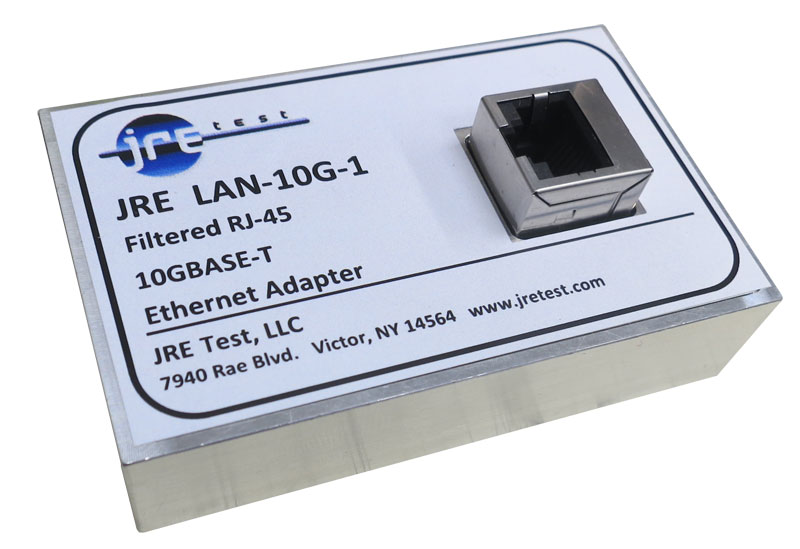
RJ-45 Filtered 10GBASE-T Ethernet Interface — JRE LAN-10G-1
Filtered 10GBASE-T (and 2.5G/5G NBASE-T) copper RJ-45 interface with patented mode-selective filtering and a 1 m jumper — not for SFP+ or fiber.
JRE LAN-10G-1 specifications
- Outside dimensions
- 2" H x 3.2" W x 0.8" D (50 x 80 x 20 mm)
- Isolation
- 80 dB isolation in test system configuration; ~80 dB conducted attenuation, 50 MHz to over 6 GHz
- Insertion Loss on Data lines
- less than 5 dB
- Conducted attenuation
- ~80 dB, 50 MHz to over 6 GHz
- Data Line Balanced Impedance
- 90 Ohms typical
- Connector
- RJ-45 Female jacks both sides of filter
- Cable included
- 1 meter Ethernet M-M jumper cable
- Power capability
- Ethernet standard or up to 60 VDC at 1 amp. DC resistance each leg, 0.1 ohms max.
- Mounting
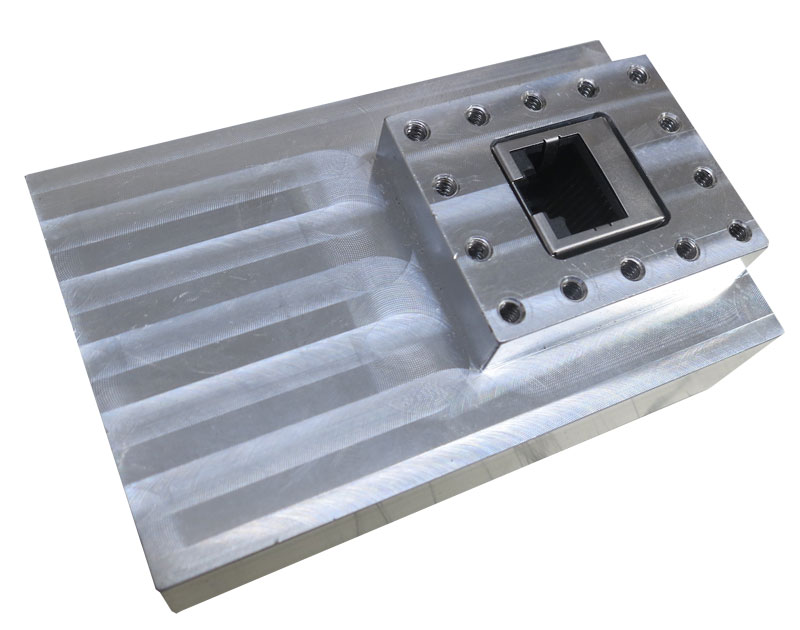
- 4-40 screws (included). Clearance hole size 0.1285" diameter - #30 or 3.3mm drill
- Housing
- Rugged machined-aluminum
- Origin
- 100% made in USA
JRE LAN-10G-1 overview
First, the one thing that decides whether this is your part: it filters 10GBASE-T only — copper, twisted-pair Ethernet on a standard RJ-45 jack. If your 10-gigabit link runs over copper RJ-45 (10GBASE-T), this is the filter. It does not work with 10GBASE-R, SFP+, or any fiber-based 10G — those are a fundamentally different serial signaling scheme (64b/66b) and need a fiber pass-through instead. And if you are only running 10/100/1000, our LAN-1 is purpose-built for those speeds and gives you better isolation there. The two are not interchangeable, so it is worth getting right before you order. Tell me what is on each end of the link and I will confirm the part.
What you get for that is a full-rate, fully 10GBASE-T-compliant link running into a sealed RF chamber with the shielding intact. It also covers the NBASE-T rates (2.5G and 5GBASE-T) that share the same balanced twisted-pair signaling.
Why it doesn't throttle your data
Older Ethernet filters simply low-pass the data lines to knock down interfering wireless RF. That worked when the data sat well below the interference. But at 10 gigabit the data climbs into the same frequency band as the Wi-Fi and cellular RF you are trying to keep out, and a low-pass filter can no longer tell them apart — it attenuates both and mangles your signal. This is JRE patented technology that works on a different principle. The Ethernet data is a balanced differential signal, while the interfering RF rides as common mode, equally on both conductors. The patented signal-phasing topology discriminates by mode: the differential Ethernet data passes through unfiltered — no low-pass ceiling on your data rate — while the common-mode RF is low-pass filtered out. That is how it holds roughly 80 dB of rejection (50 MHz to over 6 GHz) while passing the full data stream clean, with under 5 dB of insertion loss on the data lines and 90 Ω balanced impedance. Detail on the patents is on our patents page.
What it's for
- Bench-testing a networked device — a gateway, a connected security or smart-home product, network gear — over a real 10GBASE-T link inside a shielded enclosure, without the Ethernet cable becoming the antenna that bypasses your shielding.
- PoE pass-through compatible, so you can power the device under test over the same line.
- Because the path is direct copper, RJ-45 to RJ-45, your devices see a normal electrical link and negotiate any test "hiccups" end-to-end — none of the silent hang-ups a fiber media converter can hide.
- Especially useful where a conventional low-pass Ethernet filter would clobber the signal — keyfob, RFID, and similar testing.
Picking the right Ethernet filter
| Your link | Filter | Price |
|---|---|---|
| 10/100/1000 (1 Gigabit) copper | JRE LAN-1 | $435 |
| 10GBASE-T (10 Gigabit copper), one port | JRE LAN-10G-1 (this part) | $545 |
| 10GBASE-T, two ports in one housing | JRE LAN10G-2 | $1,060 |
| 10GBASE-R / SFP+ / fiber 10G | Fiber feedthrough (no filter needed) — ask me | — |
If you need two 10GBASE-T ports, the LAN10G-2 puts both in one housing — a bit more compact on the plate and a small saving over two singles.
Mounting: a ring of 4-40 screws (drilling template included for standalone installation) draws the filter flange flat and tight against the wall around its whole perimeter. Tell us what is on each end of the link and our sales team will confirm the part and quote it with freight.
Every chamber we build has a file. Your build is logged by serial number — the enclosure, the plate layout, every connector and filtered interface — with build and test records on file since 2005. Years down the road, send us the serial number and we reproduce or revise your exact configuration, with no re-engineering and no guesswork.
Go deeper
Used in: High-Speed Data
- Understanding data signals through filtered I/O The three filtering approaches — capacitive, low-pass, signal-phasing — and when each one applies.
- USB-3 and USB-C special considerations Cable length vs. speed, active cables, and why the passive filter looks like ~1–1.5 m of cable.
- The effect of adding multiple I/O filters The weakest-link principle and the 3 dB-per-doubling rule for your system isolation budget.
- Interface & connector guide Match every connector and capacitance value to your signal type on the removable I/O plate.
I/O Interfaces nearest the JRE LAN-10G-1


Tell us what connections your device needs.
Tell us what connections you need to your device under test — USB, Ethernet, RS-232, RF connectors, etc. We'll spec it out with you. No cart, no checkout: you send an inquiry and we quote it.
Ask an Engineer