
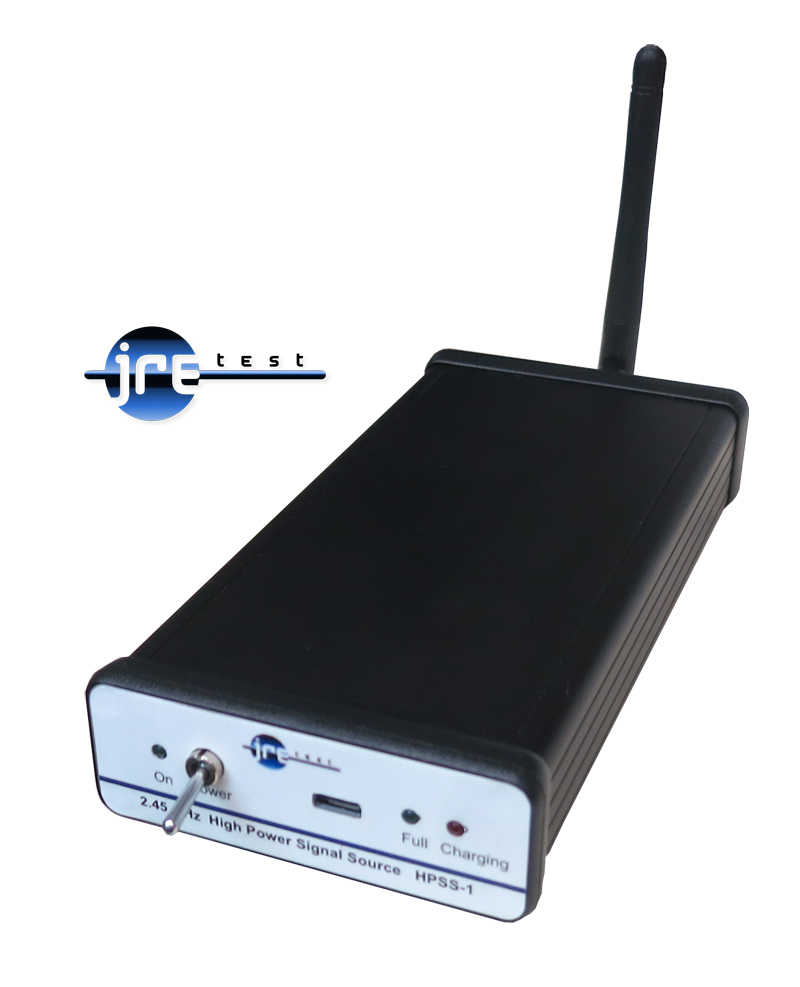
Signal source for measuring isolation of RF Shielded Test Enclosures — JRE HPSS-1
Battery-powered 2.45 GHz synthesized source with minimum +23 dBm output, designed to verify more than 120 dB of enclosure isolation.
JRE HPSS-1 specifications
- Outside dimensions
- 1.2" H x 4.75" W x 6.5" D
- Isolation
- over 120 dB
- RF Output Connector
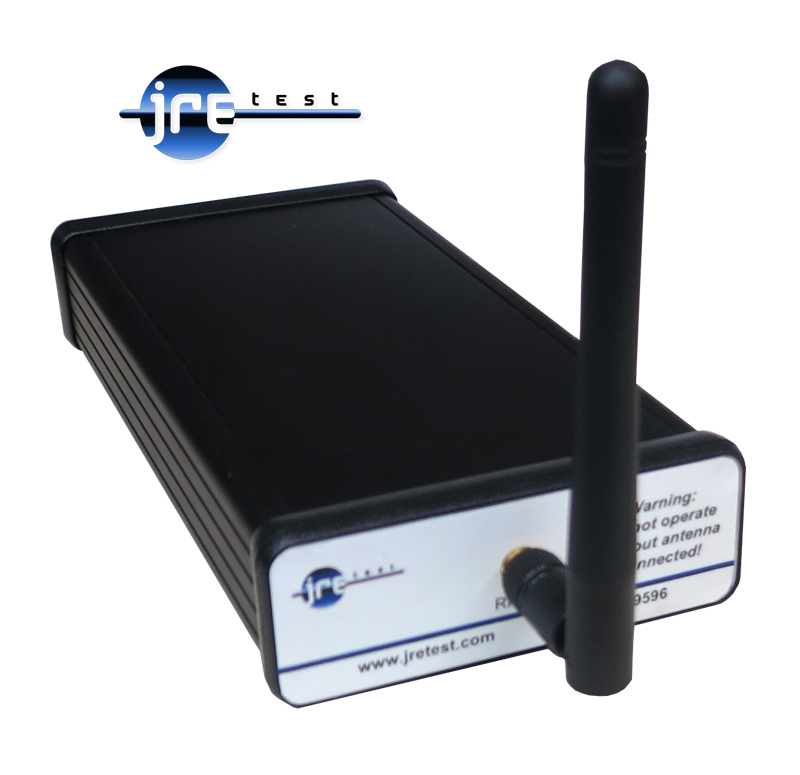
- SMA Female
- Charger Connector
- Micro USB
- Power Output
- Minimum +23 dBm, typically +25 to +27 dBm
- Operating Frequency
- 2.45 GHz
- Battery Runtime
- 4 hour runtime, uses high capacity internal rechargable battery pack
JRE HPSS-1 overview
An enclosure specification is useful, but I use a radiated source to verify that the assembled setup is still isolating. The HPSS-1 supplies that known signal from inside the enclosure without running an external power cable across the barrier. Where the lab wants a matched receiver, the STA-1 is the direct pairing.
- Synthesized 2.45 GHz source for stable readings with narrow analyzer bandwidths
- Minimum +23 dBm output, typically +25 to +27 dBm
- High output supports isolation measurements of over 120 dB
- 4 hour runtime from the internal rechargeable battery pack
- SMA Female RF output with a half-wave dipole whip antenna included
- Micro USB charger connection for the self-contained source
- 1.2" H x 4.75" W x 6.5" D rugged aluminum enclosure
Choose the HPSS-1 when the lab already has a spectrum analyzer that can tune to 2.45 GHz. The source is $1,385.00. For periodic checks after shipping or reconfiguration, battery operation keeps the measurement setup from introducing a new cable path.
Go deeper
Used in: EMC Pre-Compliance
- Measuring and verifying shielding isolation How to test the test chamber with the TVK-2 — overall isolation by Yagi, leak-hunting with E- and H-field probes.
- The effect of adding multiple I/O filters The weakest-link principle, the 3 dB-per-doubling table, and proven techniques to recover isolation.
- Taking the mystery out of RF wireless testing The overview: why a shielded chamber is needed, the −100/−95/−85 dB spec, absorber foam and verification.
- The RF absorbing foam inside your test chamber Why the foam is the damper and not the shield — 40 dB per wall bounce, and why a bare box gives you unrepeatable readings.
Test Equipment nearest the JRE HPSS-1


Tell us what connections your device needs.
Tell us what connections you need to your device under test — USB, Ethernet, RS-232, RF connectors, etc. We'll spec it out with you. No cart, no checkout: you send an inquiry and we quote it.
Ask an Engineer